
Wallpaper
Portrait of the artist as a young man in the bathroom.

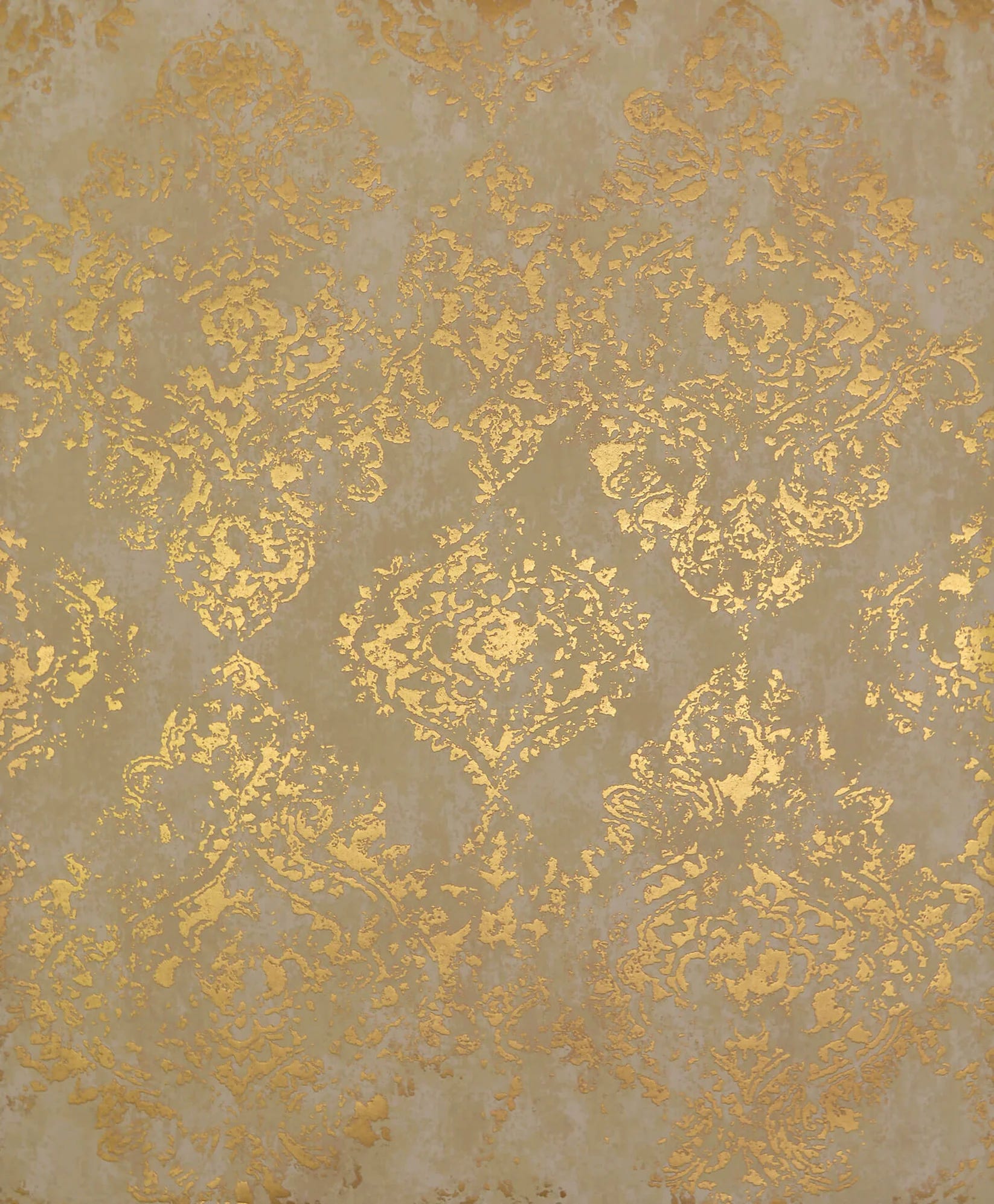
In the bathroom of the house his parents had laid in a patterned wallpaper, a sort of gold lamé with vertical strips of yellow faux velvet that ran in patterns from floor to ceiling. High-end stuff from Sears. They did a nice job with it.
It looked elegant, like you might have seen in the bathroom at Versailles or a palace in Venice or Florence, places with perfumes and unguents and scented towels. Instead they had “show towels.” You did not wipe your hands or face on them. They just hung there on the racks, fluffed and folded. They could not be touched.
On the wall there were figures and patterns, ribbons and pathways running floor to ceiling. Maybe it was a reproduction of an actual Renaissance decorative design taken from the satchel of a Florentine merchant and eventually sold and sold and resold until it made it to Sears, available to new homeowners in Staten Island to compensate for the rude American demands that even second or third generation immigrant families had to accept in order to make a living. To do whatever, a roof over your head, buy food, church on Sunday and be grateful.
To be American you had to voluntarily forfeit your inheritance of a great culture of historical and intellectual and architectural sophistication and beauty that went back millennia. O.K., they weren’t getting much out of it anyway, being peasants, but nonetheless they had to toss it — any connection to what might have been honorable and noble about the old country — and adopt the mindset of a new place, barely a country, a minor to middling blip on the timeline of civilizations. Like Sparta, not Athens or Rome, like any other nation that had mustered up enough army to carry out a genocide, clear out vast plots of land and build a Strip Mall Empire and squat there over the bones of the 50 million slaughtered.
No matter how bravely you embraced these demands, how completely you had forgotten your Tintorettos, your da Vincis, your Caravaggios and Cimabues, your Petrarchs or Vicos or Dantes, the greatness of your abandoned culture would still yearn to be expressed. No matter how many hours of overtime the city coffers gave to
your father to break his back hauling bundles or risking his life carrying people out of fires or putting fires out. He didn’t get his culture back. He got money.
And that was how you got Italianate furniture, beehive, hairdos and mothers and aunts who looked like Patty Due and Twiggy and that was how you got this wallpaper that might’ve beautified a shitter in Renaissance Florence or Venice or Paris.
But none of that really mattered to the little boy sitting there on the toilet, getting acquainted at the age of 7 or 8 with the privacy a bathroom afforded him to daydream or masturbate or become familiar with the pure physical pleasures of a healthy, briskly moving defecation and the feeling of lightness and health that followed.
It was a pleasure that no one ever sanctioned or told him about although he later suspected that what went on in the bathroom was integral to a happy life when he saw his father go in there each morning holding a cup of coffee and a cigarette, shut the door, light the butt and not come out for a half hour to 45 minutes, but now that this had become an activity that was his, no longer supervised by his mother, he had time — time alone to stare at the wall and fall into a sort of reverie as his last meal worked its way through the last stretch of his innards, and so resting his eyes on a fixed point on the wall, he saw the white shapes swimming in gold, the piping and seams that one moment appeared to be nothing, a static, formless cloud and then the next, began ever so gently to move, to swirl, as though the entire wall had come to life!
It now appeared to be populated and animated by spirits, swirling and swirling and then settling back into place, and at rest, more and more defined and now and then the profile of a woman or a face or the neck of a man would emerge, then recede but once he had seen them they would never go away.
One shape he kept returning to as it was close to eye level as he leaned forward on the wooden seat so he wouldn’t fall further down into the hole — just above the toilet paper holder — had become a profile of a woman with a lot of hair teased upward in a sort of nest and then in the space a little bit above that there was another shape that turned quite distinctly into the head and neck of a man turned and straining in a particular way, not posed, but in mid motion, in the act of doing something mundane, turning to answer a call from his child or wife, or maybe calling to the woman with the teased up hair, frozen Vesuvius-like, that head, turned to the left and slightly upward and the hollowed out chunks where the mouth would be or the slits where the eyes would be were not uniform or perfect but seemed to be dug out crudely as though out of wet clay with a flat knife or a spade and later he would see this quality in
the ancient sculptures and masks in museums or in the figures of Giacometti caught in casual, intimate motion, mundane but dreamlike and primordial. Human hands melting or shaping metal or playing with mud.
In the wallpaper he found prehistoric photographs, light-seared negatives of people in Sicily or suburban Rome or a minor protectorate engaged in the most mundane activities eight or nine hundred or even one or two thousand before, evidence of lost souls, captured there, for the eight-year-old boy on the shitter daydreaming in 1970, conjuring by his very seeing the souls who for a thousand years or more had been forgotten and by way of being forgotten cast out of existence and now at last released from the torture of nonexistence and saved, conjured now by way of the absentminded gaze of this boy who has brought the long dead back to life and so become like God.
Several years later his family moved to New Jersey. The people who moved in after his family found the wallpaper to be gauche and aesthetically confusing and so stripped the wall of the bathroom and painted it blue, like normal people.
That’s always the way, isn’t it? You make one thing and everyone who comes across it after that sees another.